34 — Work
Scaling and root planing: treating periodontitis below the gumline
Nonsurgical periodontal treatment begins with a diagnosis—not the label “deep cleaning.”
Original editorial concept · temporary
What it is
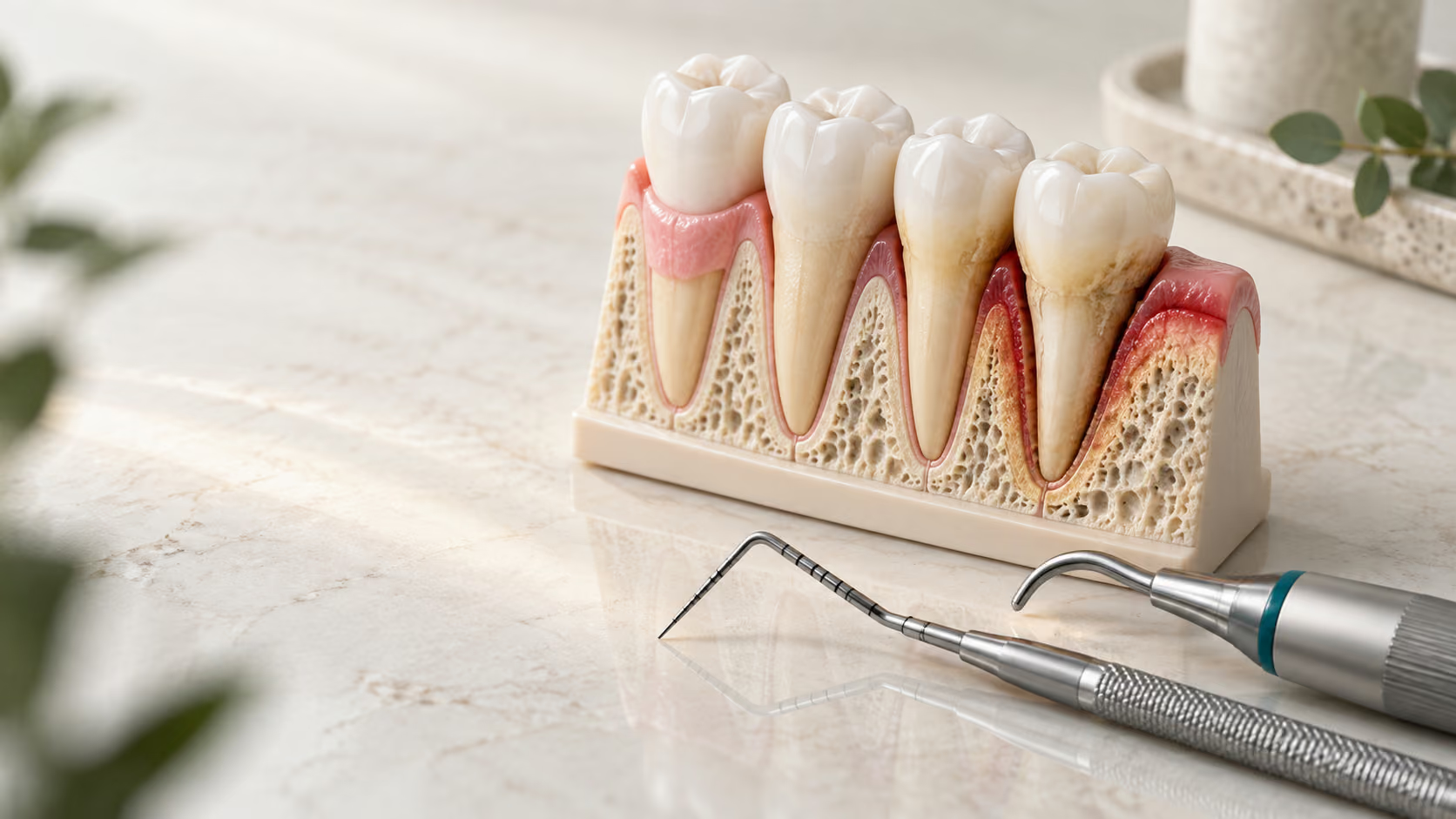
Subgingival instrumentation—commonly called scaling and root planing—is a core nonsurgical treatment for diagnosed periodontitis. The clinician disrupts and removes biofilm and calculus from affected root surfaces below the gumline so inflamed tissues can heal under better conditions. It is not the same as a routine preventive cleaning, and bleeding gums or one pocket measurement does not establish the diagnosis by itself. A sound plan connects history, periodontal charting, tooth findings, appropriate radiographs, daily plaque control, modifiable risks, comfort, site anatomy, healing, reevaluation, and long-term supportive care.
For
01
People with a periodontal diagnosis who want to understand why treatment below the gumline has been recommended.
02
Patients comparing staged or full-mouth treatment, hand and powered instruments, comfort options, or proposed adjuncts.
03
People with smoking or nicotine exposure, diabetes, pregnancy, bleeding-risk medicines, or cardiac history who need individualized coordination rather than a generic rule.
04
Patients preparing for reevaluation and deciding whether maintenance, repeat nonsurgical care, surgery, or specialist input may come next.
01 — Confirm what is being treated
History, a tooth-and-tissue examination, periodontal measurements, bleeding findings, attachment support, and indicated radiographs help distinguish periodontitis from gingivitis and other causes of attachment loss.
02 — Prepare the conditions for healing
Effective daily plaque control, professional supragingival care, smoking-cessation support, diabetes coordination when relevant, and correction of local plaque traps are integrated with treatment rather than postponed until afterward.
03 — Instrument affected root surfaces
Hand and powered instruments may be used below the gumline to disrupt biofilm and remove calculus. Selection, access, extent, and visit sequence follow the diagnosed sites, anatomy, patient needs, and clinician judgment.
04 — Individualize comfort and safety
Local pain control, medicines, bleeding risk, cardiac history, pregnancy, systemic health, and the extent of treatment are reviewed. Patients should not stop prescribed medicines based on general web content.
05 — Let tissues heal, then measure again
After an appropriate healing interval, the team reassesses inflammation, bleeding, pocket depth, attachment, home care, symptoms, and site access before deciding what—if anything—should change.
06 — Continue risk-based supportive care
Periodontitis remains recurrence-prone. Daily care and individualized professional maintenance continue even when the initial response is favorable.
Nonsurgical periodontal treatment guide
A “deep cleaning” should begin with a diagnosis and end with a measured next step.
The important question is not whether every surface can be made perfectly clean in one visit. It is whether the right sites were diagnosed, instrumented carefully, given the conditions to heal, and reevaluated before the plan advances.
The common name is not the diagnosis
“Deep cleaning” is everyday language. Scaling and root planing is generally used for instrumentation below the gumline in a patient with periodontitis. A routine prophylaxis, treatment for gingivitis, periodontal maintenance after active therapy, and nonsurgical treatment of active periodontitis are different clinical contexts. The recommended service should follow documented findings—not a label alone.
Modern evidence often says subgingival instrumentation
The practical goal is to disrupt and remove deposits and biofilm from affected root surfaces while preserving tooth structure and soft tissues. The older phrase “root planing” should not be interpreted as routinely scraping away large amounts of healthy cementum or polishing a root until bacteria can never return.
Periodontitis is diagnosed from several kinds of evidence
The clinician connects medical and dental history with periodontal probing and attachment findings, bleeding, recession, mobility, furcations, tooth prognosis, plaque-retentive factors, and radiographic bone levels when imaging is indicated. Stage describes severity and management complexity; grade estimates progression and incorporates risk. Neither pain nor an X-ray nor a single pocket reading tells the whole story.
Treatment is one step in a larger pathway
Evidence-based care begins with explanation, effective daily plaque control, and attention to modifiable risks. Subgingival instrumentation follows for affected sites. Healing and reevaluation then determine whether the patient moves to supportive care or whether selected areas need further nonsurgical treatment, periodontal surgery, a revised prognosis, or specialist and multidisciplinary planning.
Expected improvement is meaningful but individual
Across groups of patients, mechanical instrumentation commonly reduces gingival inflammation and pocket depth and may improve clinical attachment measurements. An individual response depends on initial disease, root and defect anatomy, access, smoking or nicotine exposure, diabetes control, daily plaque removal, restorations, medicines, and maintenance. Group averages are not a personal forecast.
Disease control is not a promise of cure or regrowth
Treatment cannot guarantee sterilized pockets, regenerated bone, reattached tissue, permanent tooth retention, or freedom from future inflammation. Tissues may tighten as swelling resolves, which can make roots look longer or feel more exposed. Long-term stability still depends on risk control, supportive care, and the prognosis of each tooth.
Hand and powered instruments are both established
Curettes and sonic or ultrasonic instruments can all contribute to effective subgingival instrumentation. Reviews have not established one universal instrument as superior for every patient or site. Clinicians often combine methods according to root form, deposits, access, tissue condition, restorative surfaces, efficiency, and comfort.
Staged and full-mouth schedules are planning choices
Treatment may be divided by areas or organized into a shorter full-mouth interval. Comparative evidence has not shown a clear universal advantage for one schedule. Disease extent, visit tolerance, anesthesia, medical considerations, healing, logistics, and clinician judgment shape the sequence; there is no fixed visit count for everyone.
Comfort planning belongs in the consent conversation
Instrumentation below inflamed tissue can be uncomfortable. Topical, intrapocket, or injected local anesthesia may be considered according to the sites and patient. No approach is automatically required or sufficient for everyone. Ask what sensations are expected, how pain control will be chosen, what to do after treatment, and whom to contact if recovery differs from the instructions.
Short-term effects and procedural risks should be named
Bleeding, tenderness, soreness, root sensitivity, and the appearance of recession as inflammation resolves may occur. Possible complications include persistent bleeding, soft-tissue injury, damage to a tooth or restoration, infection, or an unexpected response to anesthetic or medication. Published evidence does not justify one guaranteed recovery timeline.
Smoking and diabetes modify the plan—not the dignity of care
Smoking or nicotine exposure and hyperglycemia are associated with periodontal risk and can affect healing and response. They do not support a blanket statement that treatment is useless or automatically prohibited. A responsible plan includes cessation support when welcomed, diabetes coordination when indicated, and candid discussion of how current risk changes prognosis and maintenance.
Pregnancy is not an automatic reason to defer needed care
Professional guidance recognizes periodontal treatment, including scaling and root planing and local anesthesia when indicated, as safe during pregnancy. Medical and medication questions may still require coordination. Treatment can improve oral health, but it should not be advertised as a guaranteed way to prevent preterm birth, low birthweight, preeclampsia, or another pregnancy outcome.
Do not stop anticoagulant or antiplatelet medicine on your own
For many patients, oral bleeding can be managed with local measures while prescribed anticoagulant or antiplatelet therapy continues. The extent of treatment, bleeding history, kidney or liver function, other medicines, and medical risk still matter. Any change to aspirin, warfarin, clopidogrel, a direct oral anticoagulant, or another prescribed medicine must come from the clinicians responsible for that therapy.
Antibiotic prophylaxis applies only to selected patients
Periodontal instrumentation can manipulate gingival tissues, but antibiotic prophylaxis is not routine for everyone. Current U.S. guidance limits it chiefly to a small group at highest risk from infective endocarditis; prosthetic joints generally do not require routine prophylaxis. The dental and medical teams should verify the exact history instead of relying on a remembered rule or a website dose.
Antibiotics, antiseptics, and lasers are not automatic upgrades
Mechanical subgingival instrumentation remains the core treatment. Systemic or locally delivered antimicrobials, antiseptic products, lasers, and photodynamic therapy have indication-specific evidence and tradeoffs. Guidelines disagree about some adjuncts, and newer guidance discourages several routine uses. None should be presented as a shortcut, a guarantee of sterilization, or a universally superior replacement for instrumentation.
Reevaluation is where the next decision is earned
The team should allow enough time for a meaningful tissue response, then compare current findings with the baseline. Persistent bleeding, deep or inaccessible sites, furcation involvement, intrabony defects, mobility, restorative problems, or inadequate plaque control deserve site-specific analysis. A residual site is not automatic failure, but it should not disappear into an indefinite maintenance label.
Surgery and referral are possible next steps—not foregone conclusions
Selected residual sites may benefit from repeat instrumentation, access or pocket-reduction surgery, regenerative treatment, or another periodontal approach. Advanced disease can also require coordination with restorative, endodontic, orthodontic, or surgical care. Tooth removal is a prognosis decision, not the default consequence of one measurement.
Supportive periodontal care is active treatment
After active therapy, the maintenance plan reassesses plaque control, bleeding, pocketing, tooth and implant support, restorations, symptoms, and changing medical or behavioral risks. The interval is individualized and may change. Attendance improves the opportunity to detect recurrence early, but no schedule can guarantee that a tooth will be retained.
Know when routine follow-up is not enough
Contact the treating team promptly for bleeding that does not settle with instructed pressure, worsening rather than improving pain or swelling, fever, pus or foul drainage, an unexpected medication reaction, or another concerning change. Rapidly spreading swelling, difficulty breathing or swallowing, severe uncontrolled bleeding, fainting, or another life-threatening problem requires 911 or the nearest emergency department. A website or remote monitor is not an emergency service.
This guide does not establish a TetriSmile service
This page explains a retained legacy topic in neutral patient language. It does not prove that TetriSmile currently offers scaling and root planing, a particular instrument or adjunct, a fixed visit sequence, sedation, antibiotic prescribing, periodontal surgery, specialist coverage, or any timing, price, insurance, outcome, emergency, or location promise. Those facts require current practice evidence and clinical review before publication.
Continue the evaluation
Clinical reading
General information only. Diagnosis, treatment, risks, alternatives, and expected recovery are individual and require a clinical evaluation.
- EFP S3 guideline: Treatment of stage I–III periodontitis (2020) ↗
- EFP S3 guideline: Treatment of stage IV periodontitis (2022) ↗
- AAP/EFP consensus: Periodontitis case definition (2018) ↗
- AAP/EFP framework: Staging and grading periodontitis (2018) ↗
- ADA guideline: Nonsurgical treatment of periodontitis ↗
- Systematic review: Subgingival instrumentation for periodontitis (2020) ↗
- Cochrane review: Full-mouth versus conventional treatment schedules (2022) ↗
- Systematic review: Local anesthesia and pain during scaling and root planing ↗
- Review: Complications and treatment errors in nonsurgical periodontal therapy (2023) ↗
- ADA: Antibiotic prophylaxis prior to dental procedures ↗
- ADA: Anticoagulant and antiplatelet medicines and dental procedures ↗
- ADA: Pregnancy and dental care ↗
- Cochrane review: Periodontal treatment and glycemic control in diabetes (2022) ↗
- Systematic review: Stability and tooth loss during supportive periodontal care (2023) ↗
- NIDCR: Periodontal (gum) disease ↗
A responsible periodontal plan can show what established the diagnosis, which sites need treatment, how comfort and medical risk will be managed, what improvement will be measured, what happens if disease remains, and how the result will be maintained. Until TetriSmile’s current scope is verified, this is independent education—not a service or outcome promise.