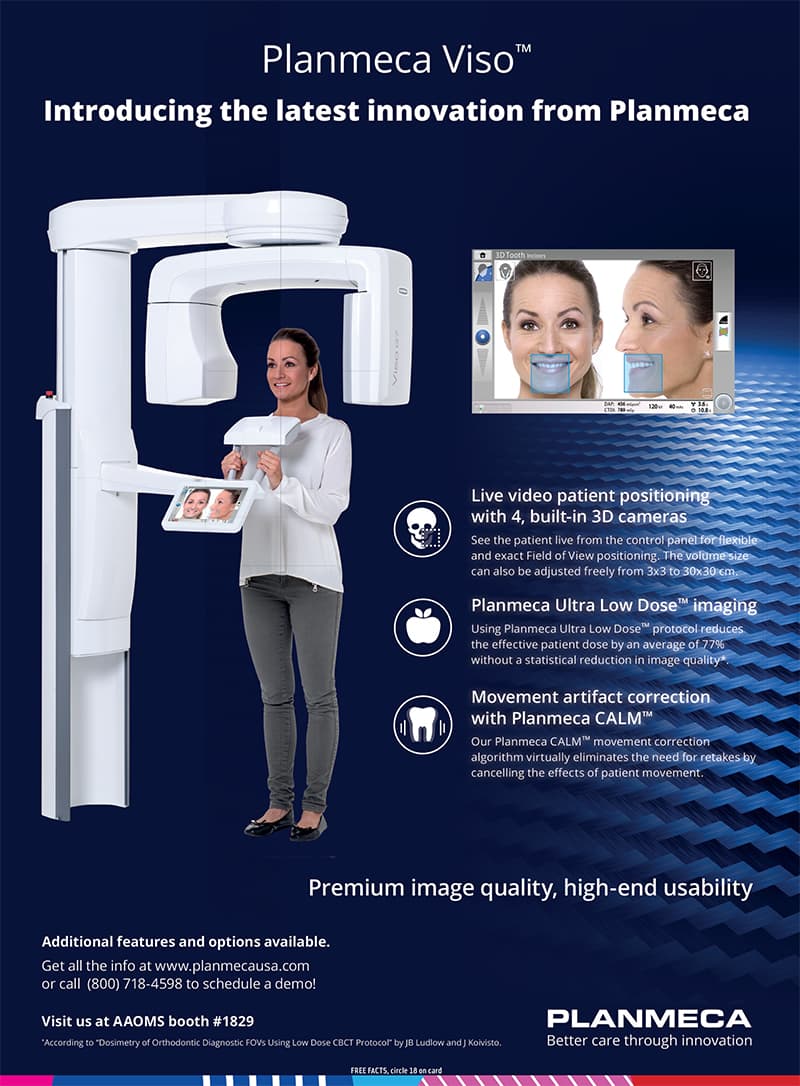

The Planmeca Viso G7 supports adjustable CBCT fields of view up to 30 × 30 cm, while Planmeca documents a 75 μm endodontic mode for focused imaging. A larger volume is not automatically better. The field should match the diagnostic question and radiation exposure should remain justified and optimized.
Romexis supports multiplanar review and planning from the acquired volume. Depending on the licensed modules and clinical need, the Viso platform also offers capabilities such as ProFace facial capture and jaw-motion records. These tools can help align anatomy and restorative planning, but they do not turn an image into a diagnosis by themselves.
Planmeca documents Ultra Low Dose protocols, CALM motion correction, and 120 kV imaging options. The operator selects the protocol according to the patient, anatomy, existing metal, and the information needed. Motion correction and artifact reduction can improve usability; they do not eliminate every limitation or justify unnecessary imaging.
The point is disciplined integration. Implant trajectories, available bone, adjacent anatomy, tissue, the proposed restoration, and functional records are brought into the same case review. For selected complete-arch cases, PIC photogrammetry and the digital laboratory may follow. The technology earns its place only when it makes the plan clearer, safer, or more reproducible.